Image by Gerd Altmann from Pixabay

‘She didn’t mind about the conviction but was concerned I’d never been to a zoo’

Author: | 16 Dec 2025

Former scholar Carolyn busts some myths about life after release, shares her passion for education’s transformative power and looks ahead to happy new year.

The five years since my release from prison have gone absurdly quickly. My release into the throes of Covid lockdowns enabled me to recover from the prison experience in a time of general uncertainty: it wasn’t just me feeling unsure of the world outside.

I’d been nervous about my re-entry into the community, particularly about meeting new people and forming friendships. Would new people in my life accept me with a conviction?

As it turned out, I needn’t have worried. Over the last five years I have made a number of new friends, no one at all having a problem with my conviction. Instead, I have faced warm acceptance and empathy that situations such as mine could happen to anyone. Slowly but surely, I have learned to have more faith in others again. I met my partner a couple of years ago and raced to explain the baggage that I come with, just so that I could get the rejection over quickly. She didn’t mind about the conviction but was very concerned that I’d never been to a zoo before. We’re getting married next year.

Looking back from where I am now, it has been such a journey. Throughout my time in prison, we were regularly fed information about what the challenges will likely be on release. I was fortunate to have accommodation sorted and I have an exceptional support network around me, reducing some of the issues that many others face on release.

Sigh of relief

Qualifying for insurance was something that came up time and again. We had it drilled into us that insurance companies can ramp up premiums for people with convictions, pricing us out of many aspects of quotidian life. This is not something that I have experienced. My conviction is still unspent and whilst, naturally, driving offences for example will mean that access to car insurance isn’t straightforward, getting reasonably priced insurance hasn’t been a struggle at all. My partner and I bought a house last year, and with that came the need for house, life, contents insurance etc. I held my breath as we submitted the forms and each time a sigh of relief came moments later, when we’d cleared the eligibility stage and been offered very decent quotes. In my experience, the blanket insurance crisis is no more than a silly prison myth.

Another of those myths is foreign travel. Yes, there are restrictions against this within most licence conditions, but these can be flexible and might dissolve over time with a reasonable and supportive probation officer. I had been told by prison officers that, even after coming off licence, travel would be tricky; a quick Google search is enough to find out that this is rubbish. So far, I’ve travelled to eight European countries (some of those multiple times) entirely without issue. We’re planning our honeymoon to South East Asia and other trips to North and West Africa and, although it’s taken a few years, I can now rest assured that my conviction won’t be getting in the way.

Making a good plan

A regular topic of conversation in prison was ‘What do you miss the most about life outside?’. For me, cooking, trail running and wild swimming were high up my list but more than anything, I missed education. My time in prison did wonders for reducing my ‘To Be Read’ pile, many thanks to my sympathetic and generous parents for bringing new books from my stack to each visit.

However, the Kafkaesque experience inside doesn’t lend itself to enhancing an educational profile. For those with a disrupted education, the availability of Functional Skills qualifications in English and maths is very useful but successfully delivering these courses to reach everyone who needs them is a tall order.

Transition back into the community has the potential to be bumpy but a way to overcome this is by making a good plan: What do you want to do and what do you need to get you there?

I now work for an organisation that supports women with convictions to access education, training and employment opportunities. We so often see women approach us for support with designing a new career path as their conviction means that their previous one is no longer accessible to them. I was in a similar position so turned to the Longford Trust to help with specialising in a new area and was given the exciting opportunity to begin a PhD. For me, studying for a degree isn’t just about rehabilitation. It’s an inspiring and experimental experience. For those I know who have gone to university for the first time after release from prison, it has been entirely transformative.

This Christmas and New Year will be significant for us as we reflect on how far we have come and look towards navigating a new stage of our life: marriage, hopefully children, entirely unchartered territory for us, and certainly an exciting time.

Studying can help people to discover their professional identity and transcend their circumstances, removing them from their interactions with the criminal justice system. If I have one bit of advice for people considering university after prison, it’s to just go for it.

Find out more about our scholarships, mentoring and employability support.
An Eye-Opening Pre-pandemic Study Trip

Author: | 8 May 2020

With the impact of Covid-19 felt across the world, travel is currently off limits. In a glimpse backwards and, hopefully, forwards, Longford scholar Wayne Haycock describes the lasting effect of a study trip to India before the pandemic.


At first, I had reservations. My last experience of international travel didn’t end well. At 16, I was arrested and imprisoned for drugs importation. That was eighteen years ago and a different me.

The prospect of a four-week placement in India stirred up deep-seated emotions from excitement to apprehension and everything in between.

I had to have a word with myself, telling myself this was as an opportunity to be grabbed not feared. Anyway, it was part of my youth work and community development university degree so important to do if I could raise the funds and get the visa. To be honest I hadn’t assumed it would be approved, so when it came through the mix of relief and fear were overwhelming.

A foreign assignment is a big deal for anyone. For me, it was massive.

Fast forward to January 2020 – before the global pandemic took hold – and I am on the plane to Kolkata (Calcutta as was) in India. On arrival at the airport, despite worries my past could be flagged up and I could be denied entry, I got straight through security. Relief.

First impressions….

Then it felt like stepping into a new world with car horns blasting and eye-watering driving, which I can only describe as an adult version of bumper cars. It all felt a bit crazy but exciting in anticipation of the experiences ahead. At the airport, I was met by staff from the Cathedral Relief Service (CRS), the organisation behind my placement. Originally it had been set up to provide refugees fleeing the Bangladeshi war in 1971 with medical, food and clothing supplies. Since then it has helped children and women with education, healthcare and vocational skills in Kolkata’s poorest areas and surrounding rural villages.

Previous thoughts of India were of the kind of images you see in travel brochures: multi-coloured landmarks, spices and bright dresses. Once there, the extreme poverty immediately jumped out at me: people living on the streets, women with children begging for anything they could lay their hands on, everyone fighting to survive. I couldn’t get my head round the normalisation and desensitisation to everyday human suffering. It was heart-breaking.

Education in action….

The educational projects I visited took me to the slum areas of Kolkata. The projects help pre- and primary school kids to gain a place at mainstream schools so that they have a fighting chance of breaking out of the poverty cycle they were born into.

What struck me most about seeing the education in action was that although generally of a good standard, it lacked special needs provision.  Children with specific learning issues like dyslexia, which makes reading and writing hard for them, simply fall through the cracks. This means 12-year-olds learning side-by-side in class with children as young as 5 as they have not been able to pass the necessary requirements to enter into mainstream education. Older children with special needs are held back until they pass. Some don’t. Older children were failing because they don’t have access to the essential specialist help they need.

I asked the teacher of this school what will happen to a particular 12- year-old boy, when his time on the educational programme finishes. She does not know, he is their family’s responsibility.

Another project that made a big impression was the women’s empowerment centre. It teaches embroidery skills to enable women to supplement their family’s income so their children can go to school and avoid begging so their family can eat. Seeing a practical project at first hand was heart-warming, how a simple intervention can bring education and a better future to families, and that making a difference to one person’s life really does have a knock-on effect to others.

Honestly, there were times when it was impossible to process both the poverty and  desperate health conditions. Meeting children dying of or orphaned by HIV in a hospice is something I will never forget. The problem is too complex to make sense of in a brief study trip. Maybe in time I will start to understand.

Looking back. The teenage girl I will never forget….

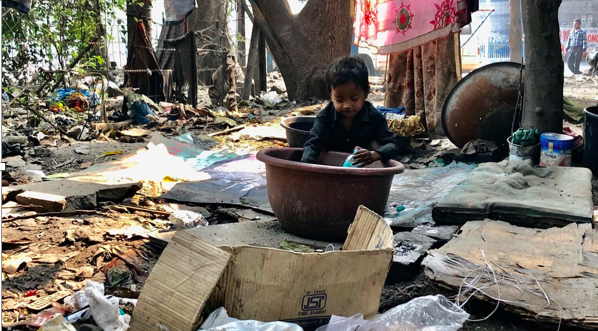
Reflecting now I am back and in lockdown, I remain struck by how the caste system was still evident although not spoken about. Yet everywhere I went it was in action, its impact obvious. For example, I visited a self-made community living alongside a railway track at a place called Brace Bridge (pictured here). Known as ‘untouchables’, the children have been born destined to struggle due to a broken social structure. They are ostracised from the rest of society, leading to terrible outcomes. Adult men marry young girls.

I met a fifteen year -old- girl with a baby.  She told me she was married at thirteen. This resonated with me.  My eldest daughter is the same age. I just cannot imagine her going through the challenges this young girl before me has. It made me question where her voice was being heard in all of this, did she have a say?

I understand India is overpopulated, but I just don’t comprehend how, in a well-resourced world, there are so many fellow human beings living in extreme poverty. After coming face-to-face with the harsh cost of people’s greed, on my return I am not prepared to accept it.

Nevertheless, my first international trip since my troubled teens was a blessing. It was an honour to take a hands-on academic ethnographic approach, to break out of the lecture hall. I have benefitted from experiencing a completely different culture and society for myself, and was blown away by people’s remarkable hospitality.

Travel is said to change people. I am undoubtedly changed by my visit to India. I had already come a very long way since the terrible trip of my youth. I was a transformed, different Wayne. Without doubt, though, I came back from India further changed.

It would be difficult for anyone to go to India, see those slums and not be humbled. Of course, we have issues within our community. As we all currently are living with the fallout from a global pandemic, I reflect on how we can always focus on the negatives in life such as what we do not have instead of what we do, my trip has helped me to appreciate the safety net of a welfare state, the NHS and the multiple services which give us the life we have.

It has made me realise how far I have come.


Wayne travelled to India with a travel scholarship from the Longford Trust.