We need more lived experience leaders in the justice system…like you!

Author: | 21 May 2021

CJ Burge has recently been appointed a new Trustee of the Longford Trust, alongside another former scholar. Here the First class degree graduate reflects on her journey from prison to boardroom, offering hope and advice to other upcoming leaders who have personal experience of prison.


I was bowled over when I got the call from the Longford Trust’s Chair to say that they would be delighted to have me as a Trustee on their Board. I was thinking “I’m the one who’s delighted, humbled, elated….!”

You see, even now, years on from my release from prison, I still suffer from impostor syndrome. Impostor syndrome is the feeling that I shouldn’t be where I am, doing the things I’m doing: sitting amongst these professionals; leading this partnership meeting; speaking on a podium to a national conference of experts; being asked for my perspective by senior government officials, and the list goes on….Impostor syndrome in this context is institutionalisation’s best friend, waiting to confront you as you leave the prison gates, hiding in your shadow as you stride forward into your new life. Although it has never quite gone away, I’ve learnt to live with it, and I’ve found that over the years, the more I’ve challenged myself to do new things, and be in new settings (that quite frankly have filled me with trepidation), the more I’ve conquered and silenced my unwelcome friend from prison.

If you’d have asked me 7 years ago, when I started my degree in prison, whether I’d be where I am today – Trustee of two remarkable charities, and a National Service Manager at another – I’d have smiled at you in incredulity and utter disbelief.

Incarceration and the prison system are far from the vessels of hope and transformation they really should be in a progressive 21st century society like ours.

Reflecting on what has got me here and how it has been possible, I’ve boiled it down to a combination of actions, mindsets and opportunities that have accelerated my path to being in leadership positions, just four years out of prison.


Actions

The one thing I knew for sure in prison was that I needed to re-educate myself. If I was going to go anywhere or do anything of significance, I needed to use the thousands of hours at my disposal to better myself as a human being, so that one day I could effectively give back to the community I would be re-entering. I was fortunate enough to get a scholarship through the Longford Trust to study Law, and with that came an amazing mentor who encouraged, inspired and challenged me, in equal measures. At the end of my degree, the opportunity to do a placement at the Cabinet Office arose, again through the Trust, and this short immersion in all things government and policy lifted the lid on what I thought was possible. It enabled me to dream the dream, that people like us could one day be in positions like those, not just as some summer intern, or token achiever, but for the knowledge, skills and much-needed lived experiences that we bring of the criminal justice services and social systems that see people at their lowest, most vulnerable state, and in much need of help.


Mindsets
The number one mantra for me has been to embrace challenge positively. I’ve known all along my journey, from 9 months’ solitary confinement in a Japanese prison, to having my daughter taken away from me at birth, to speaking in front of hundreds at a Longford Lecture or even delivering the first TEDx talk in a prison in the UK, that this would be hard, well more than hard, potentially soul-destroying if I allowed it to be. Very early on I had to come to terms with my actions that had led me to where I was and the hurt that I had caused others. I made a decision that this wasn’t the end, that no matter what, I could turn it around and, though now through a more colourful path, still fulfil my life’s ambitions to help others. Notice I said embrace challenge positively? Well positivity and gratitude are the two other mindsets that have smoothed the rocky landscapes that I have traversed. Without these I would have probably been bailing out of every challenge that came my way, but it was the positive thinking and the gratitude that kept me both buoyant and grounded, at the same time.

Opportunities

The very definition of opportunity, a set of circumstances that makes it possible to do something, may have you believe that you need to wait for those sets of circumstances to arise before you can even get a whiff of an opportunity. I see it a bit differently though, that we can engender the right circumstances by preparing and getting ourselves in a position to have opportunities line up at our door.

In my case it started with volunteering I undertook a qualification in prison delivered by St Giles in Information, Advice & Guidance, and became one of their Peer Advisors, supporting women in prison with resettlement issues. A bit later I volunteered whilst on day release (or ‘RoTL’ as it’s known) in the community in the St Giles’ Peer Advisor Contact Centre. I also secured a volunteer placement at the Southwark Law Centre.

Volunteering gave me the skills and knowledge to apply more confidently for jobs, and fortunately I secured a paid role coordinating for the award-winning educational and preventative SOS+ Service at St Giles. I can’t tell you how overwhelmed I was when I landed the job, it reduced me to tears knowing that someone out there valued me enough to pay for my contributions. Volunteering gave me a steady foundation, a base to jump off from, but that first job, being paid for the hard work I was putting in, that cemented and deep-rooted a new sense of self-worth, identity and value.

I am passionate about rehabilitation and second chances, which is why everything that the Longford Trust does resonates with me. For the last five years I have given my absolute all to developing a service that champions the potential of people with lived experiences of the criminal justice system, by providing opportunities to learn and develop skills that lead to sustainable career prospects. I am a staunch advocate for meaningful opportunities for people who leave prison, having seen first-hand the multitude of barriers for those with convictions, and the incredibly difficult circumstances many who find themselves in prison have faced. As a Trustee of the Criminal Justice Alliance (‘CJA’), I chair their Lived Experience Expert Group that meets quarterly to bring together CJA members to provide advice, support and expertise to our work on lived experience and improving the diversity of the criminal justice workforce to include, at all levels, those with lived experiences.

We need more employers and organisations in the justice sector to recognise, value, include and recruit into leadership and influencing roles people with lived experiences of the criminal justice system,

if we are “to (re)build a system that learns from those with crucial insights into the challenges that undermine the system’s key objectives” (Change from Within, CJA report 2019). Moreover, the benefits of having lived experience on non-profit boards are numerous: from “improving the quality of evidence based decision making”, to providing “credibility, legitimacy, efficiency, effectiveness,… authentic representation and a better understanding” to the issues in need of tackling, as academics from Cass Business School have found.

I am really glad to see incremental positive changes taking place across our sector with trailblazing charities, like the Longford Trust, leading the way by walking the talk and valuing lived experience. I end this blog echoing the Change from Within report’s call to action to the whole criminal justice sector, including public and private sector agencies, to recognise, celebrate and invest in people with lived experience. Whilst also encouraging all my peers to continue to welcome challenge positively, to believe in the value of and to harness their lived experiences, and always, always to aim high!



Sometimes success is not where you are now

Author: | 11 Mar 2021

Every so often we receive an email which makes us stop and really think about what we do and how to measure success. Recently Hallam, an ex-scholar from 2012, got in touch out of the blue. As far as we were concerned, he’d dropped out of university and then dropped out of view. As far as the statistics go, not a success.

But maybe we should re-think how and when to measure success. Hallam explains in his own words for Longford Blog:

I was about 13-years-old when I started offending.

At 15 I was arrested as part of a police gangs operation and by 17 I was sat in a young offenders’ institute facing significant time.

I celebrated my 18th birthday in jail; I began my ‘adult life’ on 23-hour bang up on D wing of HMYOI Brinsford in Wolverhampton, eating Jamaican ginger cake as my birthday cake.

After I was released, my family moved abroad and, because of my convictions, I wasn’t allowed to move with them.

I was 19-years-old, no family, no job and no prospects for the future other than crime.

I felt like a failure.

About a year later, I decided I wanted to do something with my life and felt joining the Royal Marines was my way out. I will never forget the moment the armed forces career officer looked at my criminal record, and laughed in my face. ‘You will never, ever join the Royal Marines, it’s not for people like you, get out of my office.’

I felt ashamed, embarrassed and angry. I felt a failure.

A path to education….

However, I stuck with my determination to do ‘something’ with my life; I would return to education.

Looking back at education, my school life was a mess. Although I actually managed to leave with 5 GCSEs (don’t ask me how, because I didn’t do any work!), I was constantly in trouble inside and outside of school, always truanting and was suspended a number of times. I didn’t value education at that time.

Despite my past experience, I enrolled at college and on a night course as well. It was a tough year. I passed both courses and was offered a place at the University of Westminster in London. It was an expensive place to live and I didn’t know if I could afford to go. That’s how I came across the Longford Trust.

Feeling safe in a different world…..

I’ll never forget that first meeting. Discussing my scholarship application in a fancy coffee shop with the scholarship manager, I remember thinking, for the first time in a very long time, that I felt safe, I didn’t have to worry about seeing someone I had issues with and it ending in violence.

It was so far removed from my daily life, but I enjoyed it. It was a seed being planted.

University life in London was a different world to me.

I remember the looks on the faces of the students I lived with when I told them about my life, like the time I was shot at and felt a bullet fly past my head. They looked horrified, I had always laughed about it before.

University was the first place I had a social circle who thought it crazy to be shot at or stabbed, and not a normal part of life.

Whilst at university I applied, and was accepted into, the Royal Marines Reserves (in spite of my past interaction at the armed forces office). I trained hard and studied, my life was on a positive path. Unfortunately, during a training exercise I suffered a significant knee injury which ended my military career before it had properly started.

My dreams were crushed, I felt deflated. I finished my first year of University but never returned.

I dropped out. Again, I felt a failure.

On paper I would have been a failed statistic for the Longford Trust. I hadn’t completed the degree I started.

But how do we measure success?

There are the obvious ways; did I pass, did I drop out, did I achieve 100%? But what about the other, less obvious successes? Like gaining experience of life outside of my area, associating with people doing legal jobs with legit ambitions, broadening my view of what was possible.

Maybe a better way to measure success is to ask if a scholar was afforded the opportunity to avoid the criminal or gang life for long enough to walk away from it? The answer for me was yes.

Fast forward to today, 10 years later: At 31-years-old, I now run a successful organisation working with young people to prevent criminal exploitation. I also work in schools using my own experiences to help safeguard children. I have travelled around the world, have a house, a stable relationship and a son. I am a better person.

On top of all of that, I am back studying at university, going into my third year of a Psychology degree through the Open University.

So why the email out of the blue to the Longford Trust? For me, starting that degree in 2012 as a scholar was the catalyst for change in my life.

The experience of attending university outside of my home city, meeting people with different life experiences and seeing a future without crime were what I needed to spark a change.

I would not be where I am today without that first chance as a student.

The degree did not change my life. The opportunity to access a new life and a new area did.

If success is only measured within small timescales, what happens to those that require a longer time to grow but eventually reach great heights?

No matter where you are today, don’t measure your success against where you are now. Learn to look at life as a series of opportunities in which seeds are planted. Some will take longer to flower than others, but no seed planted is ever wasted. You never know which one will grow to be giant.

Take the opportunity, it is so much more than a degree.

Thank you to the Longford Trust for supporting me and believing in me. Even though I failed first time round, it led me to much greater heights of success.


Life in Lockdown: Six Months On

Author: | 15 Sep 2020


Life in Lockdown: Six Months On

Last Summer our scholar Shaun wrote a blog which struck a chord and shocked in equal measure. Describing a cycle of prison, release and homelessness, he told of being given a tent to sleep in after one prison sentence.

Here Shaun, who is studying a distance learning degree, writes about his experience of lockdown…

In early March I was ready to start a new life. I was moving out of supported accommodation and had high hopes of getting a job to support my studies. Unfortunately, it didn’t work out that way…

A week after I moved into my new home, my plans were scuppered by the national lockdown. To say it was a massive blow to me is an understatement. An avid gym goer – as much for my mental well being as the physical benefits -overnight I lost something fundamental to my recovery from a serious and chaotic drinking problem. I didn’t do much in life apart from study and go to the gym. And my world was pretty solitary after cutting off negative people to better my life and create a better future for myself. To compound my isolation part-time work opportunities had fallen away.

Here I was, alone, locked off from the world.  Would I be able to cope?

I found myself getting quite low. Things were looking grim.

My old life was haunting me. The new block of flats I’d moved to were filled with people who were ignoring government advice. I witnessed people walking around like zombies scoring, taking drugs and drinking in the communal areas. As a former addict, it offered dangerous temptation.

Lockdown delivered another major personal blow. Contact with my mother ceased just as I was rebuilding a relationship with her.

Even my face-to-face contact with my mentor – we meet here and there – had fallen victim to Covid-19. We spoke via telephone and email, but it wasn’t the same as meeting up and talking in person.

I felt helpless – locked in. Able only to leave the house for essential items and no gym, it wasn’t long before I fell into drinking again. Every time I went shopping, I’d substitute a food item for alcohol. This soon escalated into a serious drinking pattern.

Suffice to say, lockdown played havoc with my life. Old styles of behaviour were creeping back. I felt myself falling deeper and deeper into a sea of depression and bad decision making. I felt like giving up on my degree.  Now, once again, I was allowing alcohol to get a hold of me. I couldn’t stay there. It was a one-way road to self-destruction if I did.

All hope seemed lost. I had to do something.

I had sought to escape supported accommodation for a long time. Now, alone, with what seemed like the world falling apart around me, I begged to go back. At times I would randomly burst into tears, although I’d never let anybody see me cry. Men don’t cry right? At least that’s what I’ve been taught. I felt weak.

It was in mid-May that I received a glimmer of hope.

I had a move date, June 3rd.

Finally, I could see a way out of the mess I was in. I had come so far, now I’d gone back. I thought I was ready to live independently again, I was wrong. Perhaps had this whole Covid-19 thing not occurred, I may well have succeeded in my plan? Who knows? It’s impossible to say. Anyway, June 3rd rolled around, and I moved back into supported accommodation. It was a massive relief.

Fast forward two months and a lot has changed for the better. Slowly, the pandemic restrictions are being relaxed. I am back at the gym, hooray!  Life in lockdown has affected us all in some form or other. I am very grateful that the Longford Trust never gave up on me and that my mentor continued to reach out to me.

Getting paid work continues to be tough. Instead, I am volunteering a few days a week with a local charity, Emmaus, something I can do alongside my studies. In the long run, this will also close the gap on my CV help my chances with future work. And I enjoy working with the charity. I give what I can in terms of time, but I receive so much more. I am building new relationships and forming a kind of social life, determined to break away from life as a recluse.

By the time you read this, you’ll realise, life in lockdown for me has been one hell of a roller-coaster ride. I have found hope again.

I hope that one day, I will be ready to live alone again, fully independent and able to deal with whatever life throws at me. It’s important to remember that we are never alone, even if it seems that way. We mustn’t be afraid to ask for help no matter what is going on around us.


Opening doors is key to success: an expert’s view

Author: | 19 Jun 2020

You may have a first-class degree and a brilliant business idea, but doors can remain firmly shut if you are not “the right sort” 

In an increasingly competitive jobs market, the Longford Trust is offering additional employment support and training to Longford scholars to turn their university degrees into successful careers.

Mark Neild is a Longford Trust Mentor and lecturer in entrepreneurship and innovation at Bristol University who has been advising our scholars. Here he writes for Longford Blog: 

It is curious that something we cannot see, touch or smell has such a huge impact on our life chances.

Social Capital refers to the resources available to people due to the connections and relationships they have.  It was popularised by the French philosopher Pierre Bourdieu who described 3 types of capital: economic, cultural and social.

Raising capital: hard with a poor credit rating

Economic capital we can all understand – in simple terms it determines our ability to buy resources.  It can be really important for those starting a business for, as the old truism goes, it is easy to raise money for a venture if you don’t need it.  For Longford Scholars, and others trying to start businesses without wealthy friends and family, they do need capital. And raising capital is doubly hard if you have black marks on your credit history.

Of course, it’s your fault if a repayment fails because the previous day a Proceeds of Crime order emptied your bank account, or if you failed to redirect your mail when you were sentenced, and are therefore denied any recourse in the County Court.  Even various charities that purport to include ex-offenders among the people they fund seem to find excuses not to support entirely plausible plans for sustainable businesses from them.

But there is good news….. 

If you look around there is support for talented business-minded people to avoid the degrading and discriminatory rituals often associated with gaining regular employment. Phoenix is a programme that works with ex-offenders to make the most of their skills to sell directly to customers. The “secret weapon” behind the programme is innovation.  We may not be able to magic up money, but we can show you how to avoid needing it.

How does that work? Well, here’s how. Much like crowd-funding, you dangle a particularly enticing proposition and show prospective partners how, with a bit of faith and investment in kind, that proposition can be realised. It is amazing how doors can open.

One Scholar’s success story

Take the first Scholar we worked with on our programme. Faced with his second institutional funding rejection, we helped him to develop a business idea that needed less capital.  By partnering with an existing landlord, he showed how the property could make more money by setting up as a halfway house for ex-offenders. And, hey presto, the landlord funded conversion works while our Scholar brought in the business. Now they both earn nicely.

But Social Capital is a different beast.  You may have a first-class degree and a brilliant business idea, but institutional doors still remain firmly shut if you are not “the right sort”.  This can be particularly problematic if your business sells to big organisations because, no matter how great your product, if you can’t pitch it nobody will ever know how great it is.  It is not that big institutions are particularly discriminatory (although, of course, some are), it is more that they are fundamentally risk averse and so struggle with ideas that originate outside their collective world view, or outside the social and cultural bubble that invisibly shapes the way they think – a point made very well by Ross Baird in his recent book, Innovation Blind Spot.

The sad truth is that procurement practice favours big companies with the resources to answer lengthy, complicated questionnaires asking about risk-management processes that, frankly, have no bearing on the quality of services delivered.  Even I, who have negotiated £billion contracts for government departments, found working through the labyrinth of the government’s new “simplified” buying process. It is a daunting and time-consuming process.  And, truth be told, unless you have the social capital to show the commissioners “what good really looks like”, they will never know and continue procuring the “same old, lame old” things.

But, hell, one of the biggest reasons for becoming an entrepreneur is to flout convention.  If a product really is better, we WILL find a way of bringing it to market.  And I am delighted to say that the Longford Trust is playing its part.  Among the current cohort of our Phoenix programme participants, we can count for four Longford Scholars, thanks in large part to Jacob, who runs the trust’s e-community app for its past and present award-holders.

Rehabilitation: ‘walking the walk’

What is particularly innovative is that each Scholar has a business idea that will improve the experience of ex-offenders in transitioning back into society.  They have been through it, so have first-hand knowledge of what needs to change, as well as the credibility with “service users” to bring about real and lasting change.

Being able to articulate persuasively the benefits of their approach is an essential part of the package. And that’s what we at Phoenix have been helping the Scholars with. It goes without saying that they need to show they don’t just have the ‘talk’, but can ‘walk the walk’. In other words, they can put in place the right systems and processes to make their vision happen.  None of this means anything, though, unless they can open the doors to the relevant commissioners.

This is where the wider Longford Trust community comes in.

Every year at the Longford Lecture hundreds of rehabilitation champions come together to celebrate talent, penal reform and second chances. Hundreds of people, many with extraordinary connections and experience in industry, business and entrepreneurialism, are united in a warm glow of good will, and ask, what can we do to help? So many Scholars have the ideas, the educational qualifications and the first-hand experience to build successful rehabilitation services. Here’s my suggestion: if you are able to open one door for one of them, please do. They might make a better job of rehabilitation than the politicians have recently!

Who knows whether it will work but, as we say to successive cohorts, the only failure is failure to try.


Spending time with lawyers focused on a fresh start

Author: | 25 Feb 2020

My day with the lawyers by Scholar Ash Rookwood….

Towards the end of 2019 Ash met staff involved in regulating solicitors as part of a training event. For Longford Blog, he reflects on the experience and what it says about rehabilitation.


The day in December when I met staff at the Solicitors Regulation Authority – the body which oversees who can and can’t be a solicitor, ensuring professional standards -was a little different from my normal routine. As a postgraduate student of Behavioural Economics, I have begun my career in the City and financial sector. I am committed to helping influence and embed positive change throughout the world, so meeting staff at the regulator seemed like a good idea – especially as they had recently reviewed their policy on applicants with a criminal conviction. I was heartened by the fact they were moving away from a one-size-fits all approach. Encouraged that they were committed to understanding more about how people make good after an offence, move on and repay second chances.

A double-act with a task….

So, what were my first impressions when I arrived at the venue in Birmingham for their away day? Everyone was friendly, keen to get to know me and what made me tick. Keen to find out about my background and circumstances of my younger life. It seemed to me that they were taking early steps in understanding someone like me and another scholar. We were a double-act, our task for the day was to tell how we had walked our path to rehabilitation.

I’m articulate and unashamedly ambitious, I’ve got my string of GCSEs, A levels and a First class, honours degree and yes, most of them had been achieved in prison through sheer hard work and determination to make the most of my potential. Just by being in the room with the regulators, showing them that someone who has been in custody can be articulate and is frankly ‘normal’ seemed an early win. It was essential in my mind to help everyone in the room to put a face to a criminal record, show them we’re not all scary and dangerous looking. I could potentially be an applicant.

The risk/rehabilitation equation.….

What emerged is an understandable priority of risk. Risk – and limiting it- both sides played into the rehabilitation equation. Weeding out who has made good, who hasn’t and who never will. As guardians of solicitors’ professional integrity, on one level risk management must, of course, be up there. But on another level, and this is one of the reasons it was so good to have the face-to-face dialogue, it is important to develop self-awareness about the need for nuance and insight, challenging perceptions. That’s why I am so pleased myself and the other scholar were able to start an important conversation.

There was one question which took me by surprise. The gist of the questioning focused on a concern about external factors. What can be done about the public perception of applicants with a criminal record? Whilst unexpected, I was pleased they’d had a chance to air the concern. They were able to articulate their fears, they have an alternative perception of what they see on the news. All we can do is give our narrative, they can reflect and address their fears. I sincerely hope that’s what we achieved.

Lessons from Hollywood

On returning to my regular professional life, it brought to mind a new film “Just Mercy”, which tells the real-life story of a civil rights attorney who defends inmates on death row in Alabama who are subject to questionable convictions.

I was lucky enough to have attended an advanced showing, and subsequently meet stars Michael B. Jordan, Jamie Foxx and Bryan Stevenson at a private dinner. Real-life lawyer Bryan Stevenson, played by Jamie Foxx – has a profound saying,

Each of us is more than the worst we’ve ever done’.

So true. Yet too often a criminal record from a terrible two or three seconds when someone is young becomes THE thing which defines them for life. They’ve done their time, just as I did. Most have shown remorse, as I have. They’ve been punished, rehabilitated and moved away from the guy they were seven years ago. Yet, the way our records system is at the moment it’s like asking someone what’s your worst mistake? Everyone has to know. Which is the opposite to how it works for most of us. When most people go for jobs, we are defined by what we do best.

As punishment- and its severity- becomes the running thread through current news, policies  and law-making, it makes it more important than ever for someone like me with ambition, goals and wholehearted commitment to continuing a successful life sits down with decision makers. It will take a while for significant changes but I’m convinced my day with the lawyers was a game-changer. I sincerely trust that it’s a step in the right direction for all lawyers in the making.


If you are interested in studying law with the support of the Longford Trust, take a look at our Patrick Pakenham scholarships for a law degree.

Best decision of my life

Author: | 18 Dec 2019

The best decision of my life. 

How evolution theorist Charles Darwin helped snap one Longford scholar out of a stupor whilst incarcerated in the US. After studying at Cambridge, here he considers his life-changing decision…..

Great Meadow.

Sounds like the name of some quaint resort set among lilies and lilacs, tall trees and lush grass.  The reality is more sombre. Great Meadow belies its name. Instead it is a rough and raw maximum-security prison in upstate New York.  It was here, behind the imposing concrete walls of this prison, I made the best decision of my life, to enrol in college.

I was pushed toward my decision by a fellow inmate who walked up to me one grey morning in the equally grey and grim prison yard.  He looked at me momentarily before asking what I was doing.  I didn’t know what he meant until he clarified that I could and should be spending my time more productively, namely by enrolling in the prison’s college programme. I looked at him, then looked past him, up towards one of several guard towers overlooking the yard and its prisoners.

Before long I was in a classroom, listening to a history professor discussing Charles Darwin and the Victorian crisis of faith.

For me, as perhaps others, education is enlightenment, a recalibration of thinking, a refocus of perspective.  The ability to see oneself and the world as not just ordinary but extraordinary.

Before college, I was adrift in prison. My thinking was adrift, and limited.  I was like someone sitting in the crow’s nest of an old whale ship.  On the lookout for whales, yet unable to see anything save miles upon miles of undulating blue sea rolling over and onward towards oblivion beneath an endless expanse of blue sky.  Like the natural elements, the flow of routine days in prison can have a hypnotic effect on the mind, on one’s outlook. The tedium can render you drowsy and numb to the point where you’re unaware of this, forgetful of that.

Education snapped me out of my stupor and instilled crystal-clear awareness.

Following my release and deportation to Britain, I was relatively confident of getting a decent job.  But after two years of working in a restaurant, I’m still searching for that ever-elusive decent job.  In the interim I have attended and graduated from the Institute of Continuing Education, an adult college which is part of Cambridge University. And, while I’m still looking for a better job than the one I presently have, I’ve been uplifted and fortified by my Cambridge education. Uplifted and gratified, for although the job search is necessary, it’s not primary.  The accumulation of knowledge and wisdom is for me the only sensible goal in life.


Meeting your idol: one scholar’s experience

Author: | 11 Nov 2019

What is it like meeting your idol who inspired a major life change?

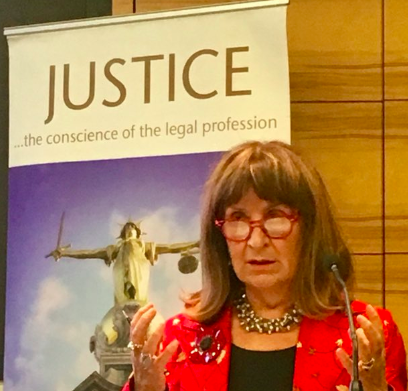
Longford scholar Emma read Helena Kennedy QC’s “Eve was Framed” whilst in prison. It sparked her decision to study law. Five years on Emma works at JUSTICE, a legal charity where human rights lawyer Baroness Helena Kennedy is President.

Longford Blog caught up with Emma during a busy working week…..


Recently you met your idol. What was that like?

Really overwhelming.  After looking up to her for so many years I was ridiculously nervous, so many people say don’t meet your heroes but she couldn’t have been nicer. She talked about her love of Longford and all it stands for. Then I told her that my personal officer in prison had given me her book “Eve was Framed” to read and about the huge impact it’s had on my life ever since. It felt as if she’d written it about me, I could relate to every word of it. Which made me cry. And that made her cry!

What struck you most about the book “Eve was Framed,” published more than 25 years ago, to highlight evidence of unequal treatment of women in the courts?

It made me realise I wasn’t on my own. At the time of my arrest there were very few refuge places left in the county I lived in. The fact that I worked full time and didn’t have children meant I wasn’t a priority for what little there was. I felt I had nowhere to go. The treatment I received from the police was incredibly poor, constantly being doubted about how bad things had been — being told multiple times, “If it was that bad, you’d just leave him”. Then finally on the day of my sentencing my barrister said to me, “You’ll be going to prison today, this judge doesn’t like women.” That’s not OK. I’ve always felt I was treated much harsher just for being female, I’ve always taken responsibility for what I did and I’ve paid the price tenfold. There are so many women in prison, just like me, with similar experiences, women who have lost their homes, their jobs and sometimes their children, just adding to the cycle of abuse and criminality. All over one mistake. We’re not immoral, or trouble makers we just need to be supported and believed. And to think it can all come down to one day, one Friday morning and a judge who doesn’t like women.

That’s not OK, I’m still really angry.

Why did that lead you to turn to education?

Really, it was down to that one book. I decided to study Law to learn about how it works, why it’s made, how it can be changed. My undergraduate degree is in Law & Criminal Justice and when I first started, I did want to become a lawyer but the more I learnt the more I realised I could have a bigger impact working in policy. Then I studied for my MSc in Clinical Criminology which is based much more on social science and the ways in which policy and law affect wider society.

And now you’re doing a six-month paid internship with JUSTICE, how is that?

I love it! It’s amazing to be taken seriously. I’ve tried to get a job for years and really struggled, so doing something I really care about with a charity doing such influential work is amazing. Everyone there has been so welcoming and supportive, I couldn’t ask for more.  I’m currently assisting on the research for a project on Racial Disparity in the Youth Criminal Justice System, which is fascinating. This is definitely the place to be to change the world!

What next?

I’d love to stay on past my six months but I know it’s not that simple. So, for now I’m working hard and make the most of it. Moving has been a huge change for me but I know it was the right thing to do. I’m becoming more and more aware of the many incredible charities doing such such important work. The opportunities are endless.

What would you say to your teenage self about reaching this point?

That’s a long time ago, and the last time I was this happy. I don’t even recognise the person I was 5 years ago… but I’m proud of myself, for the first time in my life. My confidence is growing every day. I really like the person I’m becoming.


Rocky road

Author: | 1 Oct 2019

A second chance: the rocky road to my chosen career path 

Longford scholar Toyah shares her journey

Just when I thought I had explored all options I re-evaluated my path at a crossroad. The road to the left was the golden road to social work, which is what I’ve always had my heart set on. The road to the right led to criminology or youth justice. Knowing that I always wanted to work with vulnerable people, children, young people and families I embarked on the journey with one of those destinations in mind.

Determined to stay on course, whilst in custody I was sponsored by the Prisoners’ Education Trust to do a distance learning degree in Childhood and Youth studies. I enjoyed studying and using my custodial time constructively, it confirmed I wanted to work with clients who are deemed to be challenging. But I was worried that the nature of my offence would ruin my intentions. My studies took five years of distance learning through the Open University whilst in prison, with a final year after release.  I completed six long years, graduating with a BA (Honours) in Childhood and Youth Studies. I was SO proud of myself, the journey and struggle was real.

Then reality hit, it was over. But I decided I did not want to stop there.

I decided to apply to mainstream university and apply to do a BA (honours) in Social Work. I was so excited. This excitement rapidly disappeared. I was told it would be pointless to study with a professional qualification in social work in mind. Confused, upset, I questioned why? My conviction did not relate to children or vulnerable people, so why could I not pursue my dream career? I was told I would never be granted registered status by the professional regulator for social workers, even if I presented a good case, waited a few years and had experience. I was devastated.

What to do now?

What do you do when a 10 foot lorry drives over your career path, and breaks down half way? Back to the drawing board. Trying my luck I applied for a MSc in Crime, Violence and Prevention (similar to Criminology), which I studied at London Metropolitan University. I studied part time and knowing I couldn’t afford it financially I applied to the Longford Trust for funding. I was ecstatic when I received an email stating I was awarded financial support. I successfully completed this qualification over two years part time, receiving a Merit award.

So now with a BA and Masters degree to my name, time once again to consider my path forward.  Social work kept beckoning. I looked up social work training programmes like Step Up to Social Work, Frontline to Social Work and others. Unfortunately, no luck. So I decided to apply for a Masters in Social Work at university again. Similarly, to a previous conversation, I was informed by two heads of department that I would be waste my time and money. The same obstacles were listed again.

Frustration set in. I just want to be a social worker. Why am I not being supported to fulfil my vision? I want to make a change.

Back to that crossroads, determined not to see it as a dead-end.

I had an idea.

Time to think of a different career path. My jobs as a keyworker with teenage females who are care leavers and as a women’s advocate for females who have been through the criminal justice system, I realised how rewarding my role was. I’d received lots of compliments about how well I was doing my job. That’s it! It dawned on me. Why not combine something I’m good at and something I’m passionate about and work towards it?

Fast forward to today. After speaking to multiple universities, mentors, professionals and staff at Longford Trust, I decided to pursue a Youth Justice qualification. Social work feels too big a risk, despite being encouraged by a head of children and families service for a local authority, to chase my dream.  There are just too many  obstacles stopping me from becoming a social worker. A role in Youth Justice allows me to work with vulnerable young people whom have been affected by the criminal justice system, just like I had.

What is for you, will never miss you.’

So here I am about to start my youth justice qualification course, again as a Longford scholar. I am a strong believer in the saying, ‘What is for you, will never miss you.’ No matter how many times I’ve been knocked down, doubted myself, wanted to give up and been rejected… The best way to maintain hope is get up and do something. I would not be able to swim for new horizons until I have courage to lose sight of the shore.

Youth Justice Qualification here I come. My Destination? The options are exciting and many: preventing Child Sexual Exploitation, gang and violence reduction specialist, YOT team worker, rehabilitation worker and crime reduction within families with young children.  I am determined to see obstacles as an opportunity.


Rooting for success: ex tutor’s perspective

Author: | 1 Jul 2019


Have you ever wondered what it’s like to be a tutor in prison? For Longford Blog, a former tutor (and now mentor) reflects….


Do the best you can until you know better. Then when you know better, do better. Maya Angelou

What a powerful quote, it catches me every time. These inspiring words from the late, great thinker and civil rights activist Maya Angelou hung in my classroom at the men’s prison where I worked in education for seven years. A group of university degree students made the sign for me which gave it even more meaning.

Up until Christmas 2018, I was a Tutor in prison, firstly teaching Social Skills and in the last couple of years overseeing Distance Learning.

I really enjoyed my work, feeling privileged to have worked with hundreds of students during that time.  Although, as far as I was concerned, I was just doing my job, the men I worked with constantly told me I was different from most staff they had come across in the system… that it was obvious I believed in what I was doing. I’m not sure if they were right about others. I do know what I believe. Education has the power to rehabilitate and steer people away from crime into lawful, productive lives where they can reach their personal potential. Every day I saw that and every day that’s what I strove for.

It still makes me smile, proud to think of the many men who started their transformation by learning in our department.  The journey often began because they had to study a course as part of their sentence plan. Then some – many more than you might think but not all, being honest – just got the education bug. After that they couldn’t get enough, completing every course on offer.

On a mission for every individual to achieve their potential….

So how was my unshakeable core belief in the power of education and the human capacity to change reflected in how I did my job? First things first, I tried to be student focussed in my approach. In addition, I was always solution- focussed. A ‘problem’ was something to be tackled. Perhaps most importantly though, I held every man I worked with in positive regard. What this meant is that they rewarded with confidence and respect for me.

Overcoming barriers to education in prison were part and parcel of my working life. From downloading post-graduate students’ academic texts from their online OU accounts, to allowing new students who had arrived from other prisons to access the Distance Learning room promptly so they didn’t fall behind. I was always trying to find practical solutions within the regime’s rules. If anyone had been a fly on the wall, they would have seen me running around the corridors delivering learning materials, mail and email messages from tutors to students.  I’ve heard too many stories of Higher Education students in custody held back by lack of access to course materials and resources. It can be as basic as receiving materials late – due to the slow progress through the prison system to the student. It always struck me that students in prison are often doubly disadvantaged before they even start a course. If I could do my bit to make the basics of learning in prison better, then I would.

So yes, my mission was to ensure every student had the best possible chance of fulfilling their academic potential.

As well as the practical side of things, I saw my role as helping to keep students positively motivated – especially when they were locked in their cells during evenings and at weekends.  I am a firm believer that motivation in studying translates, without doubt, into people’s long-term positive change in behaviour. Judging by my leaving cards the men noticed, writing things like,

Many people walk in and out of our lives. Yet few make an imprint. You are one of those people to make an impression that motivates and encourages without judgement.’

Another reads,

I’ve realised I am actually quite smart.’

Another talked of me never stopping for breath to help encourage and support.

Going above and beyond didn’t feel like a choice.  It was particularly exciting when men started to look for education which they could access from outside prison to quench their thirst for knowledge.  That was a brilliant moment. I can’t describe the joy a teacher feels when you see a student grow, develop and change. I don’t just mean their behaviour, but their attitude and sometimes their whole world view.  It is nothing short of a privilege to witness them transforming into happier, healthier and more positive human beings than they first set foot in a prison education department.

I honestly believe and feel proud to say that my role as tutor – and my former prison tutor colleagues – was pivotal in the students’ ability not just to succeed in their educational quest, but also for their own longterm change and rehabilitation.

Bringing the outside in….

Looking back on my time as prison tutor possibly my proudest achievement is bringing educational groups from outside into prison, breaking down the ‘us and them’ divide that prison walls too often impose.  For instance, facilitating a Post-Graduate Reading Group in partnership with University of Westminster where incarcerated men study alongside university students. Welcoming mentors – including Longford mentors who offered valuable belief in and support of several scholars – was also a legacy I am proud of, knowing that our scholars really appreciated the time their mentors took to visit and write to them. Working with the Open University, Prison Reform Trust and the Prisoner’s Education Trust is also a major achievement. These external organisations facilitated student forums, focus groups and workshops to ensure people in the criminal justice system are involved in the decision-making process. I’m very proud of the contribution the Distance Learners at the prison where I worked has made to improve not only the educational experience but also the whole custody experience for their peers and prisoners nationwide.  Their educational journey has allowed the students to grow and develop so they can articulate well to decision makers about changes to improve the experience of imprisonment.

My hopes: remaining open to new ideas and change ….

Although, just at the moment I am not directly involved in the education and rehabilitation of prisoners, I found my seven years teaching in the education department the most rewarding work I have ever done.  I was always busy, happy to support the men to make more positive choices and decisions.  I’m privileged to have been part of my learners’ journey through a spiritually oppressive system. I always rooted for them to succeed, doing my bit to help them carve out a brighter, more fulfilling present and future. I hope that my encouragement and support to the men that passed through our class, has enabled them to achieve, remain open to new ideas and change, continue learning, and achieve more. I plan to become a Longford Trust mentor and hope to support another student in a secure environment later this year.

I will forever hold Maya Angelou’s inspiration dear, because they know better, they do better and will continue to do so.


Wasting potential

Author: | 30 Apr 2019

Wasting prisoners’ potential to change their lives through education: Dame Sally Coates reviewed prison education for the government.

Here’s her verdict for Longford Blog on the newly-introduced reforms that followed her report….

In my own education world, I often hear teachers complaining that ministers in Whitehall move too quickly in introducing reforms without allowing them time to bed in. When it comes to prisons and the Justice Department, however, the opposite seems to be the case.  “Unlocking Potential”, the independent review that I lead into prison education at the request of Michael Gove, the then Justice Secretary, was delivered in May 2016.  Three years on, some of what was recommended is finally starting to trickle down into our jails.

Despite the delay, I welcome it as good news. Too many reports on how to improve our prisons end up gathering dust on shelves in Whitehall – though I can’t help remembering that Michael Gove did promise me, at the public launch of my report, to implement it, “without hesitation, repetition or deviation”.

Governor autonomy: a vital first step

His successors may not have fully honoured that commitment, but giving prison governors autonomy over how their education budget is spent, as is now happening and as was suggested in my report, is a vital first step. Governors have to take ownership of the education that is provided in their prisons – just as, for example, they take responsibility for security – rather than see it as something handed down from Prison Service headquarters.  When I was visiting prisons for my report, I came across governors who didn’t even know which organisation was providing the education in their jail.

In schools, headteachers are held to account for the education they deliver.  That is the strongest lever we have over their performance.  Prison governors need to be subject to similar scrutiny.  Having autonomy over the education budget is the best way to introduce that.  Progress is being made at last, for which two cheers out of three.

How it will work in practice….

It is not a full three because, under the new arrangements, the contracts for delivering education in prisons have been awarded to the same four providers as previously. What I had envisaged in my report was that there would be multiple providers coming into the system.  Now there is nothing wrong with sticking to the same four, if they are all good, but if governors truly are to have autonomy, then they have to be able to change providers if they aren’t satisfied with what is being delivered in their prison.  And I am not convinced that this is going to be easy to achieve under the new system.

In theory it may be possible, but because prisons have grouped together to work with particular providers, if one governor wants to hire and fire teachers, he or she can’t act autonomously but will have to go to the education provider, who employs those teachers.  If the provider then refuses, it is far from clear what happens next, but one thing is for sure. It is not going to be straightforward. Governors have a lot of other pressing matters to cope with rather than tackling poor teaching.

Room for innovation….

There are, I must stress, positive aspects to the new governor autonomy.  The DPS – or Dynamic Purchasing System – that has been introduced will give governors a budget to let out one-year contracts to bring other education providers into the prison to run individual courses. This will incentivise trying out new approaches and increase the range of options on offer to prison learners, especially in vocational subjects that don’t always sit easily in classrooms.

What’s not included?

To see if such innovation is actually delivering, though, we have to be able to monitor and evaluate it. And for that reason I am disappointed that my recommendation that every prisoner should have an individual learning plan – that follows him or her through the system, and allows the education provided to be measured against what has been agreed – still hasn’t become routine.  It remains, I am told, an ambition.  Yet without it how can governors be held to account over whether the education they are using their budgets to provide is genuinely meeting educational needs?

And where, too, is any improvement in IT access to promote education for which I argued strongly? Yes, there are now at best a handful of prisons allowing limited digital access in cells via tablets, but rarely is it set up to be used for learning.  That is such a waste! How effective it could be in encouraging prisoners to use their time in their cell to learn, and all without officers having to be involved to escort them to the education wing or the library?

Without radical reform, prisoners’ huge potential wasted….

My core belief back in 2016 was that good, targeted education is absolutely fundamental in bringing about prisoner rehabilitation.  That is why I argued in my report for a radical overhaul of the education system in prisons. What has now been introduced, however, doesn’t sound anywhere near radical enough. And that means the huge potential of prisoners to change their lives through education is continuing to be wasted.