Second chances for ex-offenders through education

About Us

Funding

To maintain and develop its projects The Longford Trust needs your help with funding. Please read all about our pioneering projects - our scholarships, our prize and our lecture - on this website. If you then feel willing to support us, please contact Peter Stanford, the Director of the Longford Trust, either via the Contact Us page of the website, or by post at the Longford Trust, PO Box 64302, London NW6 9JP.  Donations can be made via: www.justgiving.com/longfordtrust

Cheques should be made payable to the Frank Longford Charitable Trust.  If you wish us to claim Gift Aid on your donation, please make sure to say so, and include your full postal address.

An appeal for support for the Longford Scholarships

Rachel BillingtonBy Rachel Billington (right)

When my father, Frank Longford, was a member of the Garrick Club, the porter told me he could always identify my father's overcoat by putting a hand in its pocket and pulling out a bundle of letters from prisoners.

All my father's long life he was interested in the sinner and the underdog. I think he believed being the second led only too often to becoming the first. His interest in prisons and individual prisoners, which began in the 1930s and continued to his death at the age of 95, became his major cause. As a teenager in the 1950s, I grew used to nervous young men, sometimes with their even more nervous mothers, who didn't fit into the usual category of callers and in fact were people my father was helping after a spell in prison.

When I grew older, now and again I went with him to whichever prison he was visiting that week - for a couple of decades he went to two a week - and was duly shocked by the waste of life locked behind several clanging layers of doors. (On one more cheerful occasion we visited the so-called 'most dangerous man in prison' and I gaped while they fondly recalled a previous visit when they'd both displayed their skill at press-ups.) In a couple of novels, written in the 1990s, I tried to work out the alternative responses from society where murderers and those on a lesser scale of transgressions are concerned.

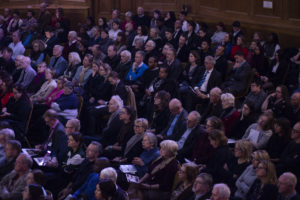
When my father died in 2001, family and friends set up an annual lecture in his memory on the subject of penal and social affairs. The first year we were addressed by Cherie Booth QC, last year by Archbishop Tutu. Despite the lectures' success, our director, Peter Stanford and the rest of us felt that my father's real personal approach to prisoners and ex-prisoners also needed to be reflected in a memorial.

As a young man he had been a don in Oxford and he had never lost his belief in the value of education to set right those straying (or strayed) off the straight and narrow. There is, I'm happy to say, increasing provision for education inside prison - almost always the most civilized area behind bars - but we soon discovered that this didn't extend to ex-prisoners. It seemed that there was a real gap here.

A young man (or woman) who has used his time usefully in prison and has gained a more positive outlook on what are his capabilities will suddenly find himself outside in the wide world with no support to take him forward. It is probably the moment when a prisoner is at his most vulnerable and also, of course, at most risk of re-offending - not good news, I may add, for any of us.

The charity closest to my heart, therefore, is the Longford Trust's very new scholarships' programme. We have high ambitions, naturally, but we have started small, both to make sure the programme is set up in the best possible form, and also because our money is still extremely limited.

This year our first two students start out under the Longford Trust's banner. Chris is 22, has spent too much of his time in prison and when outside too much of his money on drugs and drink. He is now enrolled to do an Outdoor Studies degree at the University of Lancaster.

Judith is 23 and is a psychology student at a university in the North of England. Professionals are mentoring both students and their progress will be reported back to the Longford Trust. Importantly, they are both keen to repay the help they are being given by putting something back into society, Chris as an outward bound teacher and Judith as a probation officer.

There may be only be two so far but their success will set up role models for other young prisoners, wanting to avoid re-offending and rehabilitate through education. At the moment 71per cent of 21 year olds re-offend. Maybe, in the future, the Department of Education will be impressed by the idea and follow our example.

Meanwhile we are appealing to all those who believe that the weak in our society cannot simply be swept aside and forgotten. As co-editor of the national newspaper for prisoners, Inside Time, I receive letters from inmates every week. So often education, sometimes in its widest term - I have one correspondent who is learning to make first and then play his own guitar - has the power to totally change a person's outlook.

It is the individual that makes up society and, as Archbishop Tutu suggested to us in his lecture, we are all inextricably joined in a common bond. I know that our programme will bring new confidence to those who have lost hope in finding a responsible place in society. They will have to work for it, but we want to give them that chance. Any money given to us will be received with immense gratitude.