Empty cell with sunlight shining through the window

‘The prison cell is the silent classroom of the self’

Author: | 30 Sep 2025

Before embracing education, there must be first a self-education, argues our 2025 Scholar Fedor Bryant-Dantès, studying for a BA in creative writing. Reflecting on his time in a cell, he writes of this rehabilitation process as ‘the illumination of a newly-seen self’

My experience, and similarly, that of many around me, is that each prison cell is something of a classroom. It can be the most impactful of learning environments. The prison cell is the silent classroom of the self, and it is both gratis and boundless. The only tuition fee has been my willingness to become self-aware, reflective and above all else, vulnerably honest. In a cell, my education is not delivered by rushed and tired tutors, or on pages poorly photocopied from confusing tomes, but by my ceaseless and inescapable encounters with the self; my regrets, cruelties, insecurities and fragile hopes.

So, what does it mean to experience education of the self, when the only external stimulus is isolation? Oscar Wilde, writing from Reading Gaol, understood this interrogation with more clarity, wit and verve than I could ever wish to muster. In De Profundis he declared: ‘You know what my art was to me, the great primal note by which I had revealed, first myself to myself, and then myself to the world.’ He maintained that his art was a means of understanding himself and then, allowing the world to understand him. It’s a lesson, both poetic and prophetic.

You see, in a prison cell, art is not only in painting or poetry: it is in the arduous chiselling away of false identities, the sculpting and moulding of a sincere authenticity from the raw stone of solitude. Once, I stood before that flinty surface – my soul – and began to see the outline of who I truly am.

‘Learning about oneself can feel like a revolution’

Learning about oneself can feel like a revolution more radical than any taught in academia. It is almost certainly more effective. Here, I’m not rewarded with superficially pleasing and quickly forgotten grades. Here, there are no diplomas to mount on a wall. I am both pupil and master and the day arranges itself in perpetual questions. Why did I act in anger? Why do I need them to think I’m strong? Why am I fearful of compassion? What stories have I told myself so often that I now believe them as gospel?

Long and difficult nights have been my greatest mentors. In those silent oppressive hours, my memory has unspooled like an old film reel: childhood failures, betrayals, moments of both mercy and malice. I have become adept at tracing the patterns, of mapping a terrain of my own making.

But this has not been, for me, an exercise in self-flagellation, nor a mournful pursuit for pity. Rather, it has been the forging of my resilience. Each truth unearthed and accepted is a spark. Every confession whispered to those sweating walls is a kindling. And when the gift of morning light finally filters through the narrow window, it is not simply a metaphor for new beginnings, but the illumination of a newly-seen self.

‘Our self-education is a work without precedent’

What I’ve learned to appreciate here is the undeniable art in this metamorphosis. The prisoner reduced to a barest truth is both canvas and painter. Each new brushstroke of insight, each shade of remorse or resolve, layers and builds a portrait more vibrant than any hung in galleries. Our self-education is a work without precedent – as unique and recognisable as a Modigliani or Rembrandt.

Education is rehabilitation, but education of the self is necessary, first and without equivocation. Self-education is not so much the filling of an empty vessel, but the stripping away of all that would hinder a safe departure. Self-education is an apprenticeship in honesty, and it is necessarily harsh and exacting – but ultimately liberating. For the prisoner, eventually, what greater freedom can be described than to confront one’s soul and unflinchingly to say: ‘That is who I was. This is who I will be.’

And at the conclusion of this transformation, when the outside world considers me worthy of re-acceptance, I will experience not a release but a graduation. I, who once recoiled at the perpetual closing of gates, will smile at the sound this last time. I’ll step forward having learned in that silent classroom what no syllabus could teach: that the most beneficial education is simply of the self. It is the one that turns inward and challenges self-confrontation. Bravery and honesty can help me to emerge from my current deprivation not diminished, but transcendent.

Want to know more about Longford Scholarships, or know someone who might? Contact Clare.
Isolation: an expert survivor’s guide

Author: | 20 Mar 2020

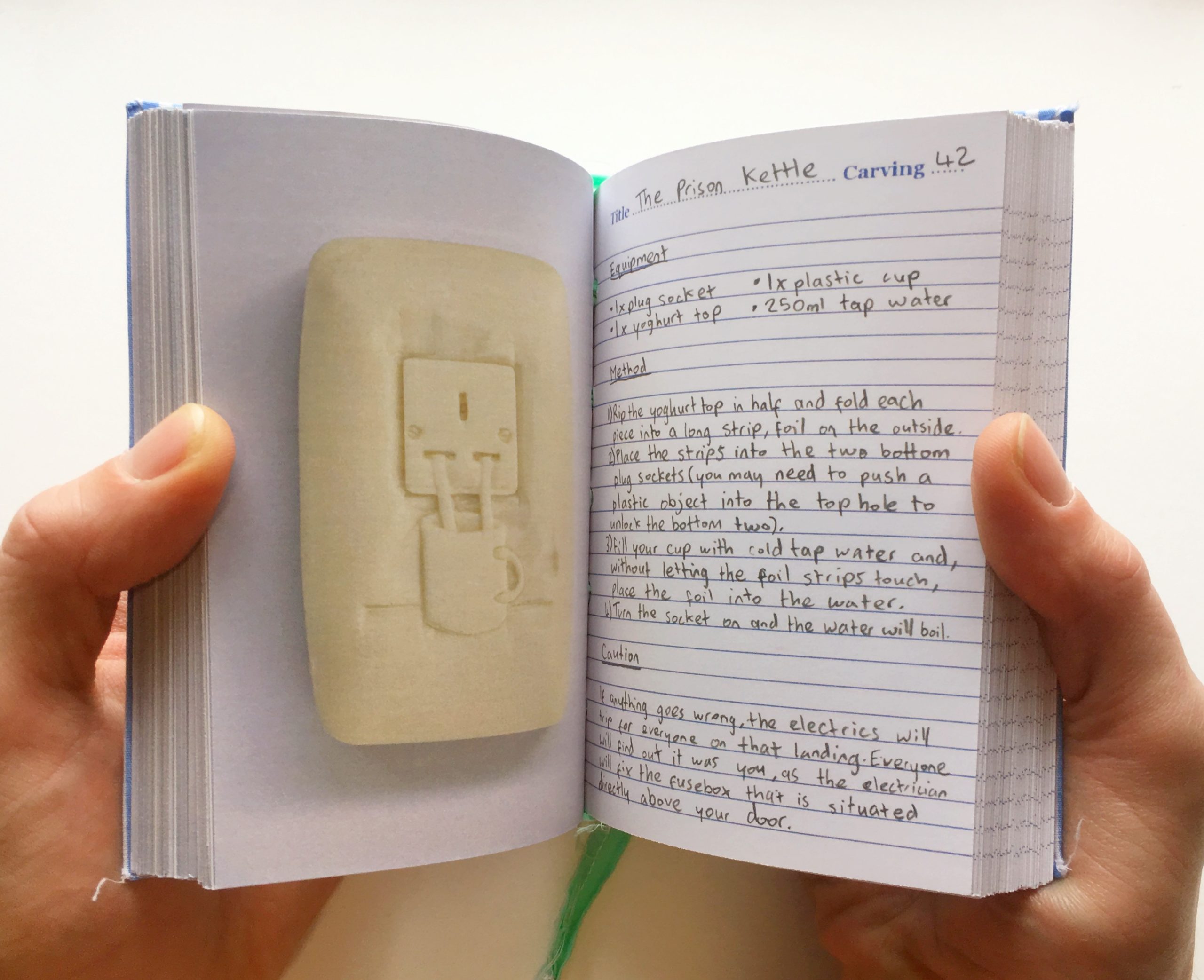
Isolation: an expert survivor’s guide by artist and former Longford scholar Lee Cutter

I know a bit about isolation. In fact, after three years in prison I am an expert.  Through this coronavirus crisis people keep asking me, ‘What’s it like in isolation? How do you cope?’ as they deal with anxiety and worry about separation from friends, colleagues and family. Everyone is searching for reassurance and tips to cope with curtailed freedom, albeit at home.

It’s got me thinking.

They say your first day in prison is the toughest. For me it came about six months into my sentence. The first day in a young offenders prison was certainly confusing and a struggle, my whole understanding of the world feeling flipped upside down, but I still had some freedom, as prison goes. This was because I was on remand, waiting for a judge to sentence me. I could work, attend classes in education, mix with others in prison – ‘associate’ as they call it inside, and go to the gym.

Just a few months on, I started to understand the environment, in an odd way, I felt part of a community. Then I was sent to Crown Court to receive my sentence. At that time, the now thankfully abolished indeterminate sentence was popular. It was a lottery whether I’d get one, carrying the real fear of never knowing when I might ever be free again. But my case was adjourned, pushed to another date. It was in the next, different young offenders prison where the pain of isolation really hit.

In limbo, I spent days and months on end in a single cell with only myself for company, locked up for 24 hours a day, with access to two phone calls and two showers a week. The prison was overcrowded, understaffed, and those under 18 were given priority to work and education. I was unlucky I was 18 years old. Though looking back, my mind felt a lot younger and I had never experienced anything like this before.

In the first few weeks I distracted myself with the television and the radio, anything to get a sense of a world beyond my four walls. During the day I’d talk with my next-door neighbour through the gap in the pipes at the end of the cell. It was at night I’d struggle with my thoughts. It’s an understatement to say the next few months were a challenge. I’d think, and think, and think. I’d think about the mistakes I had made, how they had affected people, I’d think about my family, the events that led to my situation. I wondered if it would be like this forever. It was sending me crazy. I knew I had to change, and that I’d need to teach myself how.

And then an unexpected opportunity presented itself – a pencil.

An officer had left a pencil in my cell by accident, I used it to write down my thoughts and feelings onto any scrap of paper I could gather. It took the negative thoughts out of my head, and by seeing them in front of me, it somehow helped me to understand where they might have come from, how I could change them. I began making drawings of my cell, I’d draw the sink, the bed, the window, anything in front of me. When I ran out of paper, I would draw into bars of standard prison issue soap. The soap was free on the wing and it was much more accessible than a piece of paper.

Funnily enough, I didn’t see myself as an artist, I found a creative side within me. I didn’t know anything about art, I don’t even think I liked art much at the time but I knew that making was helping me.

A few months later I was sentenced, avoiding the dreaded indeterminate sentence. This time I moved prisons again. In the new prison I had access to more arts materials, more time out of my cell. Officers and other inmates saw my drawings and soon started to give me photographs of their loved ones and pets to draw. They’d ‘pay’ me in toiletries and food. Looking back, I guess these were my first commissions.

It’s odd thinking back to those times. It feels like a different me then, and yet those times, and the isolation, have contributed to the person and the artist I am today. I’ve been out of prison for ten years now, have completed a BA degree in Fine Art, with support from the Longford Trust, got a postgraduate at the Royal Drawing School. I now have a much sought-after job with Koestler Arts – encouraging people in prisons and other secure settings to engage in the arts. I am proud to say I have achieved what many artists never manage, exhibiting in the prestigious Royal Academy, Northern Gallery for Contemporary Art, Christie’s, the upmarket auction house and the Royal Festival Hall. And I am now a mentor for an artist through the Longford Trust who is studying a distance -learning degree in prison. I often think about what life is like for him being creative in his prison, I can see confinement shapes his work.

As we all face the isolation of coronavirus and restrictions in our daily lives and relationships I wouldn’t wish this uncertain period of confinement on anyone. One silver- lining is perhaps the insight it offers, a window into imprisonment. The lack of control, unable to go out when you feel like it, prevented from learning in a classroom or library when you choose, no longer seeing or hugging a grandparent –the punishing impact of not doing what used to be normal. I hope and trust we will all dig deep in this coronavirus, finding some hidden talents – as myself and my mentee have done with art. Spare a thought for the 80, 0000 plus men, women and children in overcrowded, often dirty prisons across England and Wales who know isolation and resourcefulness all too well. Next time someone says prison is too ‘soft’ remember this time and remind them what it felt like during the coronavirus crisis.


Find out more about Lee and his hand-made book An Inside Story, a hand bound with prison bedsheets and visitation shirts here: https://www.koestlerarts.org.uk/shop/books/an-inside-story/